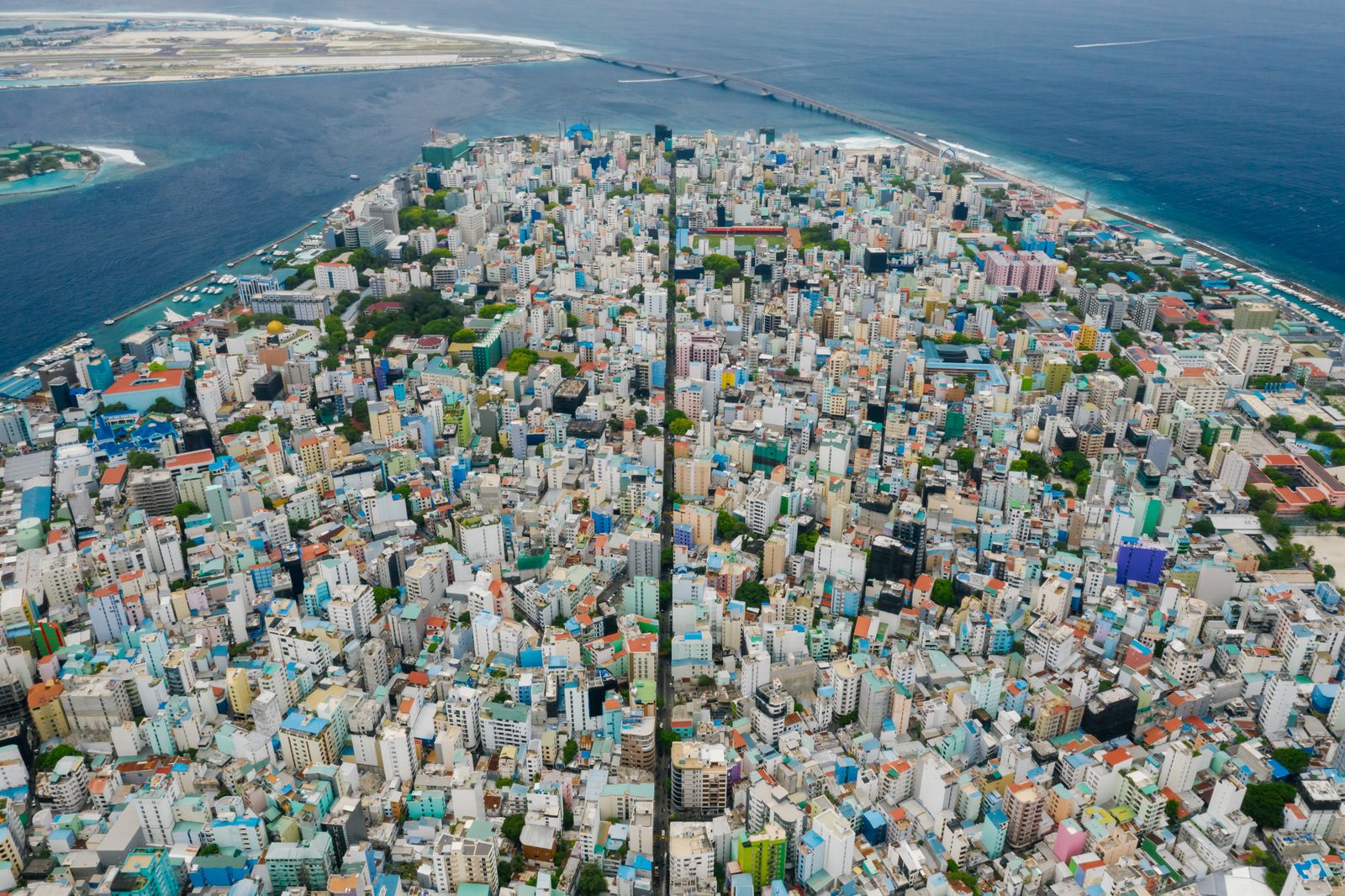
Hulhumalé does not look like the other islands. It is flat, grid-planned and still growing, built on sand pumped from the lagoon to ease crowding on the capital. Most visitors pass through on the way to a resort or a local island, but the town repays a few hours.
01
Why the island was raised
Malé is a small, dense city island with almost no room left to build. Hulhumalé was raised from the shallow lagoon to the northeast to take some of that pressure, giving the capital somewhere to put new housing, schools and services without reclaiming more of Malé itself.
The work was done in stages, with sand pumped up and the edges protected before anything was built on top. The exact dates and the number of phases are best confirmed with an official source, as the programme has been extended more than once since the first land appeared.

02
A town that was drawn first
Most inhabited islands in the Maldives grew slowly around a harbour, a mosque and a grove of palms. Hulhumalé was drawn on paper first. Its streets run in a grid, its plots are regular, and its open space was set aside before the buildings went up.
That makes it feel different from a traditional island. There is no old village core and no winding lanes between coral-stone walls. What there is instead is a young town with wide roads, a beach on its eastern shore, and a mix of apartment blocks, shops and public buildings filling in over time.
03
The airport next door
Velana International Airport sits on Hulhulé, the island immediately to the southwest, and the seaplane terminal is on the same airport island. Hulhumalé is close enough that many travellers treat it as an airport suburb rather than a destination in its own right.
Connections between the islands have changed over the years as bridges and causeways have been added, and further road links have been planned or built. Check the current arrangements with your guesthouse or the official transport sources before relying on a particular route.
- By road: a causeway and bridge network links the airport island and Malé, with arrangements changing as work continues.
- By ferry: public ferries and airport shuttles run between the islands; timetables change, so ask locally.
- On foot: much of Hulhumalé itself is walkable, with pavements along the main roads.
04
What there is to see
The eastern shore has a long public beach, with a reef close enough for a swim at the right tide. It is a working town beach rather than a resort beach, and the usual local-island rules apply: swimwear belongs on the designated stretches, and shoulders and knees are covered elsewhere in town.
Away from the water, the interest is in watching a planned town take shape. There are mosques, schools, a hospital and a growing number of cafes and shops, and new districts rising on land that was lagoon a few years ago. The population and the built area are growing quickly, so any figure quoted is soon out of date.

05
Practical points for a visit
Hulhumalé is a local island, not a resort. Alcohol is not sold, importing alcohol and pork is not allowed, and Friday midday prayers close many businesses for a while. During Ramadan, eating and drinking in public in daylight is avoided.
Many travellers use the town for a night before an early seaplane or after a late arrival, since it is close to the airport and cheaper than a resort. Guesthouses can arrange transfers, and the same guesthouses know the current ferry and shuttle times.
06
Using it as a base
Because the airport is next door, Hulhumalé works well as a first or last night. Seaplanes fly in daylight only, so a late arrival often means an overnight on the ground before a morning flight to an atoll. Speedboats can run day and night, which suits the atolls close to the airport, North and South Malé in particular.
From the town, the rest of the country is within reach: the resorts and local islands of North Malé Atoll, the dive sites and sandbanks of South Malé, and the domestic and international flights that leave from Velana. The town itself is a short introduction to how the Maldives is changing, not a substitute for the islands further out.
- North Malé Atoll: resorts and local islands a short speedboat ride from the airport.
- South Malé Atoll: dive sites and sandbanks within reach of the capital.
- Domestic flights: regional airports such as Dharavandhoo and Maamigili, with a boat transfer usually following.
- Seaplane: daylight-only flights from the terminal on the airport island.
FAQ
Questions people ask
Is Hulhumalé a resort island?+
No. Hulhumalé is an inhabited local island with guesthouses, homes, schools and mosques. Alcohol is not sold there, swimwear is limited to designated beach areas, and shoulders and knees are covered in the town. Resort islands work differently, with one resort per island and alcohol served.
How do you get from Velana airport to Hulhumalé?+
The airport is on Hulhulé, the island next to Hulhumalé, and the two have been connected by road links and causeways that have changed as construction has continued. Ferries and shuttles also run. Ask your guesthouse for the current arrangement, since routes and timings change.
Why was Hulhumalé built in the first place?+
It was raised from the lagoon to relieve pressure on Malé, which is a small, dense city island with very little land left. Hulhumalé gave the capital somewhere to put new housing and services. The programme has run in phases, and further phases have been planned, so exact dates are best checked with an official source.
Can you swim at Hulhumalé?+
Yes, on the public beach on the eastern shore, at the right tide. It is a town beach rather than a resort beach, so the local-island rules apply: swimwear only on the designated stretches, and shoulders and knees covered elsewhere. Check conditions locally before swimming.
Is Hulhumalé a good place to stay before a seaplane?+
It can be. Seaplanes fly in daylight only, so a late arrival may mean an overnight on the ground before a morning flight. Hulhumalé is close to the airport and has guesthouses, which makes it a practical first or last night. Your guesthouse can advise on transfer timing.
How big is Hulhumalé and how many people live there?+
The town has grown quickly and is still expanding, with new districts built on land that was lagoon not long ago. Population and area figures date fast, so any number quoted is soon out of date. For current figures, check an official source rather than relying on older guides.
Does Hulhumalé feel like a traditional Maldivian island?+
Not really. It was planned on paper before it was built, with a grid of streets, regular plots and open space set aside in advance. There is no old village core or winding lanes between coral-stone walls. It is a young town, and it looks and feels like one.
What rules apply on Hulhumalé during Ramadan?+
Hulhumalé is a local island, so during Ramadan eating and drinking in public in daylight is avoided. Friday midday prayers close many businesses for a while at any time of year. Importing alcohol and pork is not allowed. Check with your guesthouse if you are unsure what applies during your stay.
What is there to do on Hulhumalé itself?+
The main draws are the public beach on the eastern shore, the mosques and public buildings, and watching a planned town take shape, with cafes and shops in the newer districts. Most visitors use it as a base for the airport rather than a destination. The resorts and dive sites of North and South Malé Atoll are within reach.


