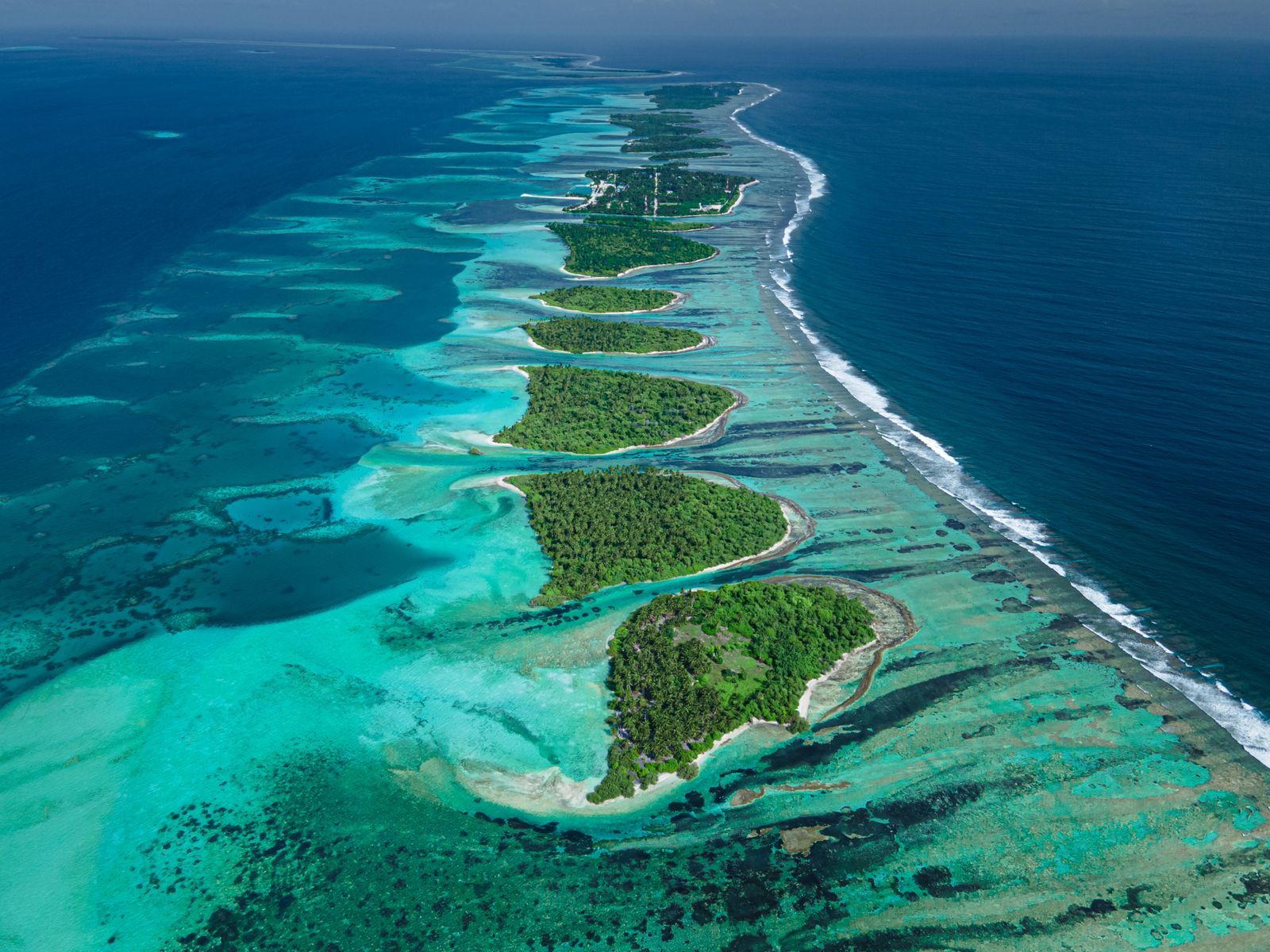
South Malé Atoll is the southern half of Kaafu, separated from North Malé by a deep channel. Inhabited islands such as Maafushi, Guraidhoo and Gulhi have guesthouses, while resort islands occupy their own reefs. The atoll is within speedboat range of Velana International Airport, which makes it a straightforward first stop.
01
South Malé in two minutes
South Malé Atoll is the southern part of Kaafu, the administrative atoll that also contains North Malé. The two halves are divided by a deep channel. Its administrative code letter is H, used on island signs and ferry boards.
The atoll mixes two kinds of island. Inhabited islands such as Maafushi, Guraidhoo and Gulhi have guesthouses, village streets, mosques and harbours. Resort islands are private, with one property to an island and alcohol served. Maafushi is one of the busiest local-island destinations in the country, with a concentration of guesthouses and cafes.
The eastern rim is where the atoll gets its reputation among divers. Channels cut through the reef edge and carry current, which brings fish and makes for drift diving. Guraidhoo Kandu is a protected dive site.
- Speedboat: the usual transfer from Velana International Airport, day or night.
- Guesthouse islands: Maafushi, Guraidhoo and Gulhi.
- Resort islands: private islands with their own transfers and house reefs.
- Diving: drift dives in the channels along the eastern rim.
02
Getting there
South Malé Atoll is close to Velana International Airport, so the usual transfer is by speedboat. Speedboats can run day and night, which suits arrivals that land after dark. Resorts arrange transfers for their guests, and guesthouses on the inhabited islands arrange them for theirs.
There is no need for a seaplane or a domestic flight to reach this atoll. The seaplane terminal is on the same airport island, but seaplanes fly in daylight only and are used for islands further away. For South Malé, the boat is the standard route.
Public ferries link some inhabited islands within the atoll on set days, and a ferry connects Malé with the local islands. Timetables change, so ask your guesthouse for the current ones. The bridge links Malé with the airport island, which helps if you spend a night in the capital first.

03
Guesthouse islands
Maafushi is the busiest of the local islands in South Malé. It has a harbour, a long stretch of guesthouses, cafes and dive schools, and a designated bikini beach where swimwear is allowed. The village itself is conservative: shoulders and knees are covered away from the beach, and alcohol is not served on the island.
Guraidhoo is smaller and quieter, with a harbour and a village centre. It sits close to Guraidhoo Kandu, the protected channel dive, which makes it a base for divers. Gulhi is smaller again, with a beach and a short walk from one end to the other.
On all three islands, Friday midday prayers close many businesses for a time. During Ramadan, eating and drinking in public in daylight is avoided. Importing alcohol and pork is not allowed.
- Maafushi. The busiest guesthouse island, with a bikini beach and many cafes.
- Guraidhoo. A quieter village island close to the eastern channel dives.
- Gulhi. A small island with a beach and a short village walk.
04
Channels and drift dives
The eastern rim of South Malé Atoll is cut by channels that connect the open ocean with the lagoon. When the tide runs, water pours through these channels and carries plankton, small fish and the larger fish that feed on them. Divers drift with the current along the reef wall.
Guraidhoo Kandu is a protected dive site and one of the better known channels in the atoll. Grey reef sharks, eagle rays and schools of fusiliers are among the fish that gather in the current. The dive is usually made on a running tide, and the boat picks divers up down-current.
Maldives regulations cap recreational diving at 30 metres. Dive centres in the atoll run trips to the channels and to reef sites inside the lagoon, and they judge conditions on the day. Currents can be strong, so experience and a guide matter.

05
Resort islands
Resort islands in South Malé follow the national pattern: one island, one resort, with alcohol served and transfers arranged by the resort. Many have a house reef close to the beach, and some run excursions to the channels and to sandbanks.
Guests on the local islands can sometimes visit a resort for the day, where the resort allows it. This is arranged through the guesthouse or the resort, and a fee is usually charged. It is a way to spend an afternoon on a resort beach without moving your base.
The atoll's resort islands sit on their own reefs, some close to the eastern channels and some inside the lagoon. The choice between resort and guesthouse usually comes down to budget, alcohol and privacy rather than distance, since both are within speedboat range of the airport.
06
Practical notes
The year turns on two monsoons. Iruvai, the northeast monsoon, runs roughly from December to April and is drier and calmer. Hulhangu, the southwest monsoon, runs roughly from May to November, with more wind, passing showers and choppier crossings. Air and sea stay warm all year.
Surfing in the Maldives has a season roughly from March to October, with the biggest swells around June to August. The northeast monsoon months bring smaller, cleaner waves on some breaks. Breaks near Malé are reached by boat from the local islands.
Reef care applies everywhere. Touching or standing on coral, collecting coral or shells, and feeding fish all harm the reef, and taking coral or shells out of the country is not allowed. Dive centres and guesthouses can explain the rules for the protected sites.
FAQ
Questions people ask
Which islands in South Malé Atoll have guesthouses?+
Maafushi, Guraidhoo and Gulhi are the main inhabited islands with guesthouses. Maafushi has the largest concentration, with cafes and dive schools. Guraidhoo is quieter and close to the eastern channel dives, and Gulhi is smaller again. Each has a designated bikini beach, and alcohol is not served on any of them.
How do you reach South Malé Atoll from Velana airport?+
The usual transfer is by speedboat, which can run day or night. Resorts arrange transfers for their guests, and guesthouses on the inhabited islands arrange them for theirs. There is no need for a seaplane or domestic flight. Confirm the pick-up point and time with your accommodation before you fly.
What is diving like in the channels of South Malé Atoll?+
The channels along the eastern rim carry current on a running tide, which makes them drift dives. Fish gather in the flow, including grey reef sharks and eagle rays. Guraidhoo Kandu is a protected dive site. Recreational diving is capped at 30 metres, and dive centres judge conditions on the day.
Is Guraidhoo Kandu suitable for new divers?+
It is a channel dive with current, so it suits divers with some experience and a guide. Dive centres in the atoll assess conditions and diver experience before taking a boat out. New divers can build experience on reef sites inside the lagoon first, then join a channel dive when the centre agrees.
Can you drink alcohol on the local islands of South Malé Atoll?+
No. Maafushi, Guraidhoo and Gulhi are inhabited islands, and alcohol is not served there. It is served on resort islands and on licensed boats. Importing alcohol and pork into the country is not allowed. Resort day visits are one way to spend time on a resort island without changing your base.
What should you wear on the guesthouse islands of South Malé Atoll?+
Swimwear is for the designated bikini beaches only. In the village, shoulders and knees are covered. This applies on Maafushi, Guraidhoo and Gulhi. Friday midday prayers close many businesses for a time, and during Ramadan eating and drinking in public in daylight is avoided. Guesthouses can explain local expectations.
When is the best time to visit South Malé Atoll?+
The northeast monsoon, roughly December to April, is drier and calmer. The southwest monsoon, roughly May to November, brings more wind and passing showers. Air and sea stay warm all year. Divers may prefer the calmer half, while surfers look to the March to October season, with the biggest swells around June to August.
Are there surf breaks near South Malé Atoll?+
Yes. The surf season in the Maldives is roughly March to October, with the biggest swells around June to August. The northeast monsoon months bring smaller, cleaner waves on some breaks. Breaks near Malé are reached by boat, and guesthouses on the local islands can arrange trips with local surf guides.
Can guests on South Malé Atoll's local islands visit a resort for the day?+
Sometimes. Some resort islands allow day visits from local islands, arranged through the guesthouse or the resort, and a fee is usually charged. Availability and rules vary by resort and can change, so ask your guesthouse to check before you plan a day around it.


