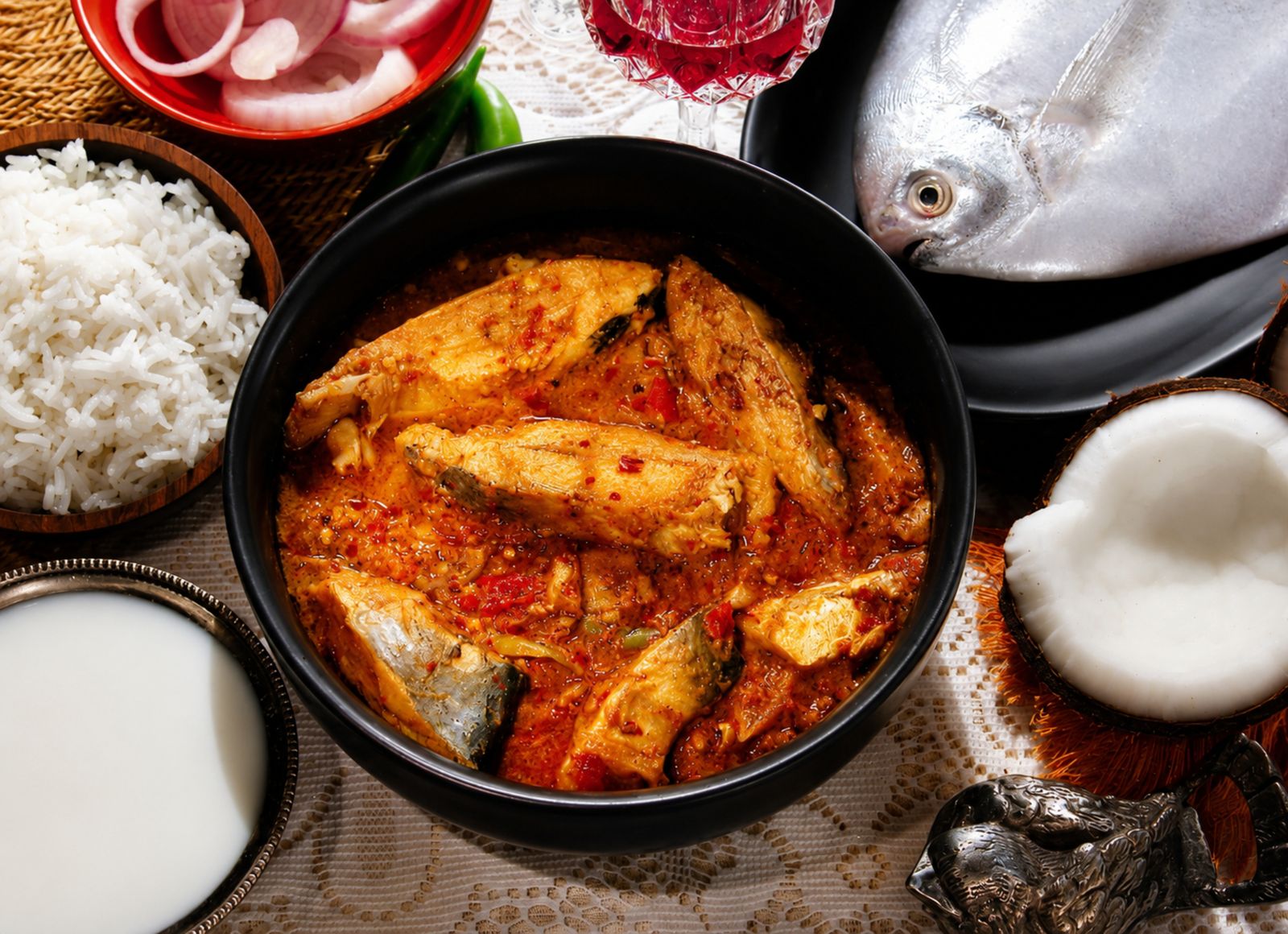
Tuna is the backbone of the Maldivian diet, and curry is how most of it is eaten. Skipjack is the usual catch, though other species are used. The fish is cooked with coconut milk pressed at home, onion, chilli and curry leaves, and served with rice or flatbread.
01
What the dish is
Tuna curry is a household dish, not a restaurant one. Fresh tuna is cut into chunks and simmered with grated coconut milk, sliced onion, chilli, curry leaves and a mix of spices. The result is a thick, fragrant curry that is mild or hot depending on the cook and the family's taste.
It is eaten at any meal. In the morning it may come with roshi, the thin flatbread cooked on a hot pan. At lunch and dinner it is more often served with rice, sometimes with a second vegetable curry or a plate of pickled fish on the side. The same curry appears at all three meals in many homes.
02
Tuna at the centre
Tuna is the main protein of the islands. Skipjack is the usual catch, though other species are also used when they come in. The fish is landed daily and either cooked fresh or preserved by smoking and drying, which is how island kitchens have always kept fish for the days between catches.
The smoked fish gives the curry its depth. It is often added alongside fresh tuna, or used on its own when fresh fish is scarce. The local name for the smoked fish varies between islands and households, so it is best to ask your host or the cook what they call it. The flavour is strong, salty and smoky, and a little goes a long way.
- Fresh tuna: cut into chunks and simmered until just cooked.
- Smoked tuna: gives depth and salt; used alone or with fresh fish.
- Chilli and curry leaves: the everyday seasoning, with onion and spices.
- Coconut milk: grated and pressed at home, the base of the sauce.
03
Coconut, grated and pressed
The coconut is not a background ingredient. In island kitchens it is grated from a mature nut, then squeezed by hand to press out the thick first milk. Water is added to the pulp and pressed again for a thinner milk, which is used to loosen the curry. The first milk goes in near the end, so it does not split.
This is everyday work, done on a stool with a grater, and the milk is used the same day. The same coconut may also give oil for frying the onion and spices at the start. Nothing is wasted: the pulp goes to the chickens or the compost.

04
How it is cooked at home
The method is simple and varies by household. Onion, chilli and curry leaves are fried in oil, then spices are stirred in until fragrant. The tuna goes in next, then the thinner coconut milk, and the curry simmers until the fish is cooked and the sauce thickens. The thicker milk goes in at the end.
Smoked fish, if used, goes in early so it can soften and flavour the sauce. Some cooks squeeze in a little lime for sharpness, or drop in a piece of pandanus leaf. The curry is not usually a long, slow braise; it is a quick everyday dish, made after the fish comes in and eaten the same day.
05
At the table
At home the curry is served in a shared bowl, with rice or roshi on the side. Each person takes what they want. In many households the rice is plain, and the curry is the only wet dish, so the sauce is soaked up with the bread or spooned over the rice.
On local islands, the same curry is a common guesthouse meal, and it is worth asking for it. It is not a special-occasion dish, and that is the point. It is what people eat on ordinary days, and it tells you more about the island than any restaurant menu.
06
Variations between islands
There is no single recipe. The amount of chilli, the balance of fresh and smoked fish, and the spices used all change from island to island and from one kitchen to the next. Some curries are thin and soupy, others thick and dry. Some are bright yellow with turmeric, others dark brown from the smoked fish.
What stays the same is the pattern: tuna, coconut, chilli and curry leaves, eaten with rice or roshi. That pattern is the everyday staple, and it is the dish to know if you want to understand what Maldivians actually eat.

FAQ
Questions people ask
What fish is used in Maldivian tuna curry?+
Skipjack is the usual catch, though other tuna species are also used when they come in. The fish is landed daily and cooked fresh, or preserved by smoking and drying. Smoked fish is often added to the curry for depth, either alongside fresh tuna or on its own when fresh fish is scarce.
Is tuna curry eaten for breakfast in the Maldives?+
Yes. It is an everyday dish and appears at any meal. In the morning it is often served with roshi, the thin flatbread, while at lunch and dinner it is more usually eaten with rice. Many households eat the same curry at all three meals, sometimes with a vegetable dish on the side.
How is the coconut milk made for tuna curry?+
At home, a mature coconut is grated and squeezed by hand to press out the thick first milk. Water is added to the pulp and pressed again for a thinner milk. The thin milk goes into the curry early, and the thick milk is added near the end so that it does not split.
What gives tuna curry its smoky flavour?+
Smoked and dried tuna, often added alongside fresh fish or used on its own. The local name for the smoked fish varies between islands and households, so ask your host or cook what they call it. It is strong and salty, and a small amount gives the curry its depth.
Is tuna curry spicy?+
It can be, but the heat varies by household. Chilli is a standard ingredient, and some cooks use more than others. If you are eating with a family or at a guesthouse, say if you prefer it mild, and the cook can adjust. The curry is not usually overpowering, but it is not bland either.
Can I eat tuna curry on a local island?+
Yes. It is home cooking, and many guesthouses serve it or will make it if asked. It is not a restaurant dish, so the best place to try it is at the table of a guesthouse or a local family. Ask in advance, as the fish is bought fresh that day.
What is tuna curry served with in the Maldives?+
Rice or roshi, depending on the meal. At breakfast, roshi is common. At lunch and dinner, plain rice is usual, with the curry spooned over it. Some households add a vegetable curry, pickled fish or a fresh chilli on the side, but the tuna curry is the main dish.
Does tuna curry use fresh or smoked fish?+
Both are used. Fresh tuna is common when the catch is landed, and smoked or dried fish is used to give depth or when fresh fish is not available. Many cooks use a combination of the two. The balance changes from island to island and from one kitchen to the next.
Is tuna curry the same everywhere in the Maldives?+
No. There is no single recipe. The chilli, spices and balance of fresh and smoked fish vary between islands and households. Some curries are thin and soupy, others thick. What stays the same is the pattern of tuna, coconut, chilli and curry leaves, eaten with rice or roshi.


