
Thundu kunaa are the woven mats of the Maldives, made from reeds that grow in the southern atolls. The work is often done by women, and the patterns are geometric and figurative. The mats are used in the home and given as gifts.
01
Reeds, cut and dried
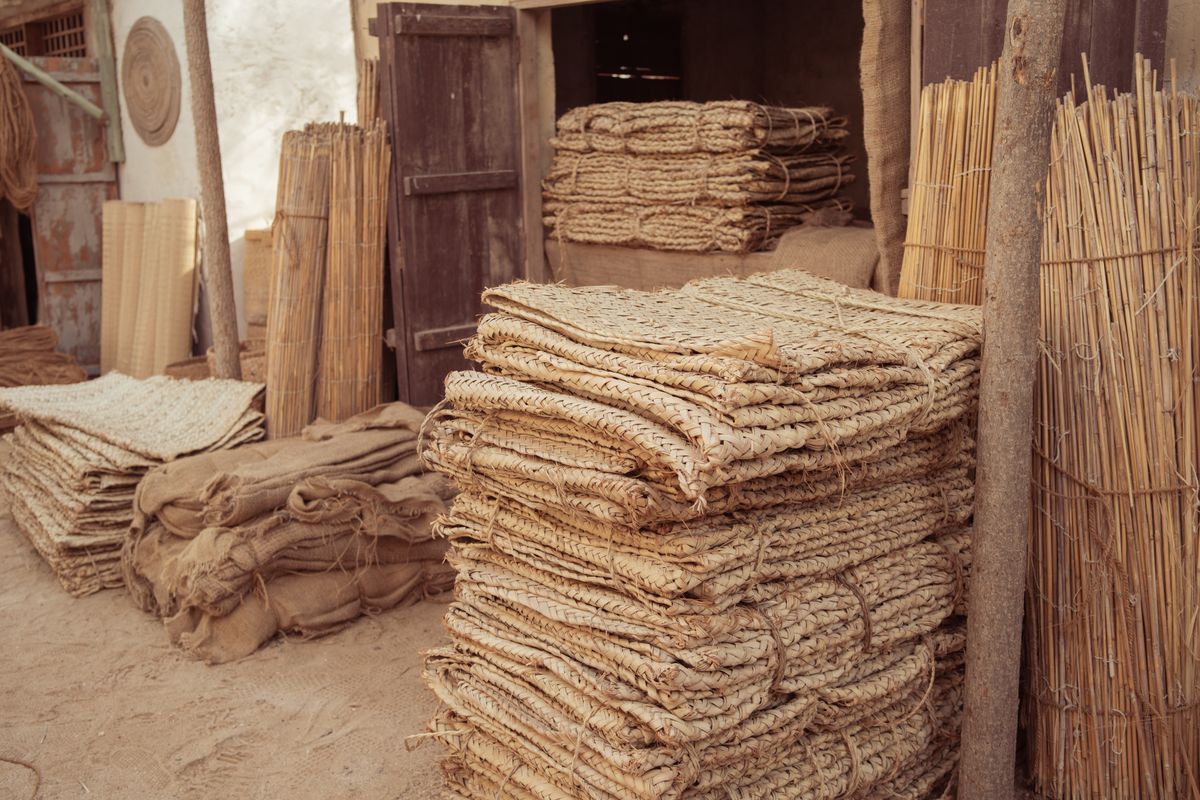
The raw material for thundu kunaa is a reed that grows in the southern atolls. It is cut, then dried in the sun before it can be worked. The drying matters: damp reed will not take dye evenly and will not lie flat in the finished mat.
The prepared reeds are split or trimmed to a workable width. From this point the craft is a matter of patience, with bundles of reed sorted by size and colour before weaving begins.
The reed beds are part of the island landscape in the south, and the harvest follows the seasons rather than a fixed calendar. Weavers know their own local beds and the right stage at which to cut.
02
Colour from roots and bark
Traditional thundu kunaa are coloured with natural dyes. Roots, leaves and bark are gathered and prepared, and the reeds are soaked or boiled to take the colour. The palette is earthy: browns, blacks, reds and yellows, depending on the plant and the mordant.
Synthetic dyes are now also used, and some mats combine natural and synthetic colour. The choice affects the depth and evenness of the colour, and the way it ages.
The dyeing is often the slowest part of the work. A batch of reeds may be dyed several times to reach the required shade, and the results vary from one batch to the next.
- Roots: used for deep browns and blacks.
- Leaves: give greens and softer tones.
- Bark: yields reds and warm browns.
- Mordants: fix the colour to the reed.
03
A simple loom, steady hands
The loom used for thundu kunaa is a simple frame, often no more than a set of bars and a beam. The weaver sits at it and passes the dyed reeds over and under the warp, building the pattern row by row.
The work is often done by women, and the knowledge passes within families. A large mat can take weeks, depending on the complexity of the pattern and the time the weaver can give to it.
The tension of the weave decides whether the mat lies flat and wears well. A well-made mat is dense and even, with the pattern clear on both faces.
04
Geometric and figurative patterns
The patterns on thundu kunaa are both geometric and figurative. Bands of triangles, diamonds and checks alternate with motifs that represent plants, fish or other island subjects. The arrangement is often symmetrical, with a border and a central field.
Each motif has a name in Dhivehi, and the vocabulary of patterns is passed down. Some designs are associated with particular families or islands, though the craft is best described as belonging to the southern atolls rather than to one place.
The pattern is not drawn on the mat. The weaver counts the reeds and builds the design as the rows grow, which is why a complex mat demands close attention.
05
In the home and as a gift
Thundu kunaa are household objects. They are laid on the floor for sitting and sleeping, spread for prayer, and used to cover benches or chests. A good mat is part of the furnishing of a home.
They are also given as gifts. A mat may be presented at a wedding or taken to relatives, and the quality of the weaving is understood by the recipient. The gift carries the maker's time and skill.
In recent years the mats have found a place as decorative pieces, hung on walls or used as table runners. The craft continues, though the number of active weavers is small.
06
Seeing the craft in the south
The weaving is associated especially with the southern atolls, including Gaafu, though the specific islands where it is practised vary. It is not a performance for visitors; it is work done in the home or in a small workshop.
A visitor who is invited to watch should expect to observe rather than participate. The weaver's time is the main ingredient, and a quiet visit is more welcome than a crowd.
The finished mats can sometimes be bought on the island where they are made. Buying directly supports the weaver, though the supply is limited by the pace of the work.

FAQ
Questions people ask
What are thundu kunaa made from?+
Thundu kunaa are woven from reeds that grow in the southern atolls. The reeds are cut, dried in the sun, and then dyed before weaving. The finished mat is dense and flat, with the pattern visible on both faces. The reed is a local material, and the quality of the harvest affects the finished mat.
Are thundu kunaa always dyed with natural colourants?+
Traditionally the reeds were dyed with roots, leaves and bark, and natural dyes are still used. Synthetic dyes are now also used, and some mats combine both. The choice affects the shade and how the colour ages. Natural dyes tend to give softer, earthier tones, while synthetic dyes can be more uniform.
Who weaves thundu kunaa?+
The work is often done by women, and the knowledge passes within families. Weavers may work at home or in a small workshop, and a large mat can take weeks to complete depending on the pattern. The craft is learned over time, and the skills are handed down from one generation to the next.
What patterns appear on thundu kunaa?+
The patterns are geometric and figurative. Bands of triangles, diamonds and checks alternate with motifs representing plants, fish or other island subjects. Each motif has a Dhivehi name, and the design is counted rather than drawn. The arrangement is often symmetrical, with a border and a central field.
Which islands are known for thundu kunaa?+
The craft is associated especially with the southern atolls, including Gaafu. The specific islands where it is practised vary, and it is best to ask locally or through a guesthouse whether weaving can be seen. Some islands have a longer tradition of the craft than others, but the knowledge is not confined to one place.
How are thundu kunaa used in the home?+
They are laid on the floor for sitting and sleeping, spread for prayer, and used to cover benches or chests. They are also given as gifts at weddings and to relatives, and the quality of the weaving is understood by the recipient. A good mat is part of the furnishing of a home.
Can visitors buy thundu kunaa?+
Finished mats can sometimes be bought on the island where they are made. Supply is limited by the pace of the work, and buying directly supports the weaver. Ask through the guesthouse about availability. The mats are also sold in some shops in Malé, though the choice may be smaller.
Is thundu kunaa weaving a dying craft?+
The number of active weavers is small, and the work is slow. The mats are still made and used, and there is interest in the craft as a decorative piece. Whether it continues depends on weavers passing on the knowledge to others. Visitors who buy mats help to support the craft.
How long does a thundu kunaa mat take to make?+
A large mat with a complex pattern can take weeks. The time depends on the size, the density of the weave, and the hours the weaver can give. Dyeing the reeds adds further time before weaving begins. A small mat with a simple pattern may take less time, but the work is always slow and careful.


