The Maldives is not an easy destination for travellers with reduced mobility. Sand, steps, boat boarding and small aircraft set the terms. Some resorts have made real improvements, but nothing can be assumed. The workable approach is to ask specific questions of each place before booking, and to arrange help at the airport in advance.
01
Limited and uneven provision
Accessibility provision in the Maldives is limited and varies greatly from one island to another. There is no national standard for step-free access, and no single source of reliable information. A resort that suits one traveller well may be impossible for another with different needs. The only dependable method is to describe your requirements precisely and ask for confirmation in writing.
The physical setting works against easy access. Islands are small and low, with sand tracks rather than paved roads. Boats are boarded from beaches or jetties, and buildings often have a step at the entrance. None of this means a trip is out of reach, but it does mean that planning has to be individual rather than general.
02
Transfers and boats
Seaplanes are difficult for travellers with reduced mobility. Boarding involves steps up from a floating pontoon, and the cabin is small with limited room to move. Staff can help, but the operation is not designed for wheelchairs. A seaplane transfer should be discussed with the resort and the operator before booking.
Speedboats present their own challenges. Boarding usually means stepping down or across from a jetty or beach, and the boat moves with the swell. Crews are used to helping passengers, but a boat with a level boarding point is not the norm. For anyone who cannot manage steps or a moving deck, a speedboat crossing may be the hardest part of the journey.
Domestic flights use small aircraft with their own boarding steps, and a boat transfer usually follows. The same questions apply: how many steps, how wide are the doorways, and can staff assist. Ask the resort or guesthouse to confirm each leg of the journey, not just the flight.
- Seaplane: steps to board, small cabin, daylight only.
- Speedboat: moving deck, step across from jetty or beach.
- Domestic flight: aircraft steps, then a boat to the island.
- Airport assistance: arrange with the airline before travel.
03
Resort and guesthouse design
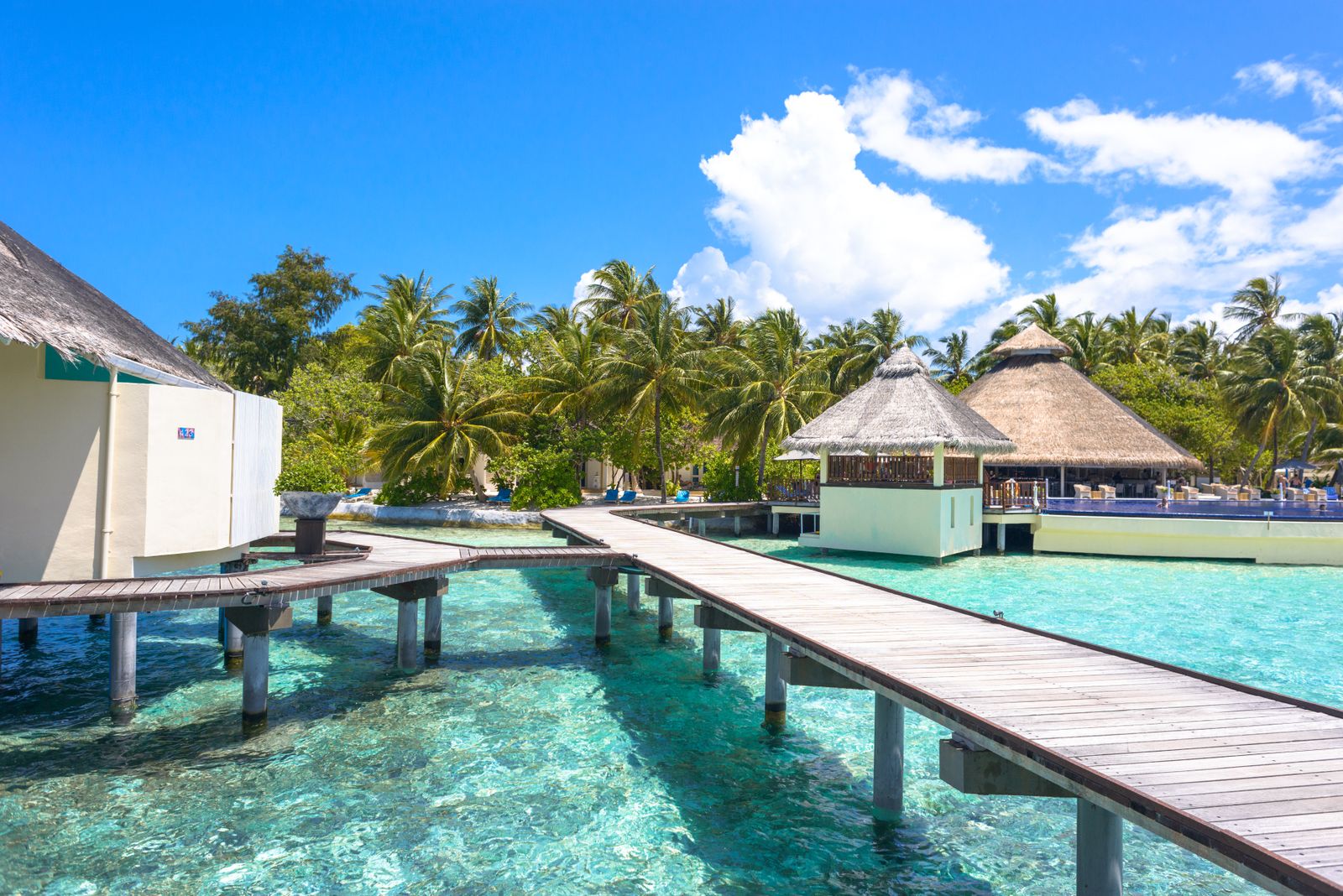
Many resorts have some accessible rooms and paths, but the details matter. A room may be step-free inside while the route to the restaurant crosses soft sand. Overwater walkways often have raised edges and no handrails. Beach villas may sit a few steps above the sand. These features are common, but each resort is different, so ask for photographs and measurements rather than a general assurance.
Guesthouses on local islands are usually smaller and less likely to have adapted rooms. Village paths are sandy and uneven, and the harbour and mosque may be reached by steps. That said, some guesthouses are on flat ground close to a bikini beach and can work well for a traveller with limited walking range. The guesthouse itself is the best source of accurate information.

04
Malé and Hulhumalé
Malé is a dense city island with narrow streets, high kerbs and busy traffic. Pavements exist in places but are not consistently wheelchair-friendly, and crossing roads can be difficult. Hulhumalé, the reclaimed island next to the airport, is flatter and more open, with wider roads and some paved walkways. Neither island is fully accessible, but Hulhumalé is generally easier to move around.
The airport itself has assistance services, but these must be arranged in advance with the airline. Do not assume that help will be available on arrival without a prior request. The bridge between Malé and the airport island carries vehicles, and taxis are the usual way to cross.
05
Medical facilities
Medical facilities are limited outside the capital region. Malé has hospitals and clinics, but on resort islands and local islands the provision is usually a small clinic or a first-aid point. For a traveller with a condition that may need treatment, this is a serious consideration. Travel insurance that covers evacuation by air is essential.
Some resorts have a resident nurse or doctor, but this is not universal. Ask the resort directly what medical cover is on the island and how a transfer to Malé would be arranged in an emergency. The answer will help you decide whether the island is suitable.
06
What to ask before booking
Contact the accommodation directly, not just the booking agent, and describe your needs in specific terms. Ask about the number of steps to the room, the width of doorways, the bathroom layout, and the route to the beach, restaurant and pool. Ask for recent photographs. A general statement that a resort is accessible is not enough.
It also helps to ask about the transfer in detail: how you board the boat or seaplane, whether staff can lift a wheelchair, and whether a ground-floor room can be guaranteed. Keep the replies in writing. If the answers are vague, treat that as information in itself.
- Room access: steps, doorway widths, bathroom layout.
- Resort routes: path surfaces to beach, pool and restaurant.
- Transfer: boarding method and staff assistance.
- Medical: on-island cover and evacuation plan.
FAQ
Questions people ask
Can I reach a resort by seaplane if I use a wheelchair?+
Seaplanes are difficult for wheelchair users because boarding involves steps from a floating pontoon and the cabin is small. Some operators can assist with a transfer, but this must be arranged in advance with the resort and the seaplane company. Do not assume it will be possible without written confirmation.
Are speedboat transfers suitable for someone with reduced mobility?+
Speedboats can be challenging. Boarding usually means stepping across from a jetty or beach onto a moving deck. Crews often help, but level boarding is not standard. Ask the resort or guesthouse to describe the boarding point and whether staff can assist. For some travellers, a speedboat is the hardest part of the trip.
Do Maldives resorts have accessible rooms?+
Some resorts have rooms designed for reduced mobility, but there is no national standard and provision varies. A room may be step-free inside while the route to the restaurant crosses sand. Ask for specific details and photographs of the room and the paths you will use. Confirm in writing before booking.
Is Malé wheelchair-friendly?+
Malé is not consistently wheelchair-friendly. The city is dense, with narrow streets, high kerbs and busy traffic. Pavements exist in places but are uneven. Hulhumalé, the reclaimed island near the airport, is flatter and more open, with wider roads and some paved walkways, though it is not fully accessible either.
How do I arrange airport assistance at Velana International Airport?+
Request assistance from your airline before you travel, usually at least 48 hours in advance. Confirm what will be provided at Velana and at any connecting airport. Keep a copy of the confirmation. Do not rely on finding help on arrival without a prior request, as provision may be limited.
What medical facilities are available on local islands for someone with reduced mobility?+
Medical facilities outside the capital region are limited. Local islands usually have a small clinic or first-aid point rather than a hospital. For anyone with a condition that may need treatment, travel insurance covering air evacuation is essential. Ask the guesthouse what cover is available and how a transfer to Malé would be arranged.
Can I visit a local island with reduced mobility?+
It is possible, but local islands present challenges. Paths are sandy and uneven, and some buildings have steps. Some guesthouses are on flat ground close to a bikini beach and can work well. Contact the guesthouse directly with your specific needs and ask for details of the route from the jetty to the room.
Are overwater villas accessible for people with reduced mobility?+
Overwater villas often have raised walkways with no handrails and may be reached by steps. Some resorts have added ramps or handrails, but this is not standard. Ask the resort for photographs and measurements of the walkway and the villa entrance. A beach villa may be easier for some travellers.
What should I ask a resort before booking if I have reduced mobility?+
Ask about the number of steps to the room, doorway widths, bathroom layout and the surface of paths to the beach, pool and restaurant. Ask how you board the transfer boat or seaplane and whether staff can assist. Request recent photographs and keep the answers in writing. Vague replies are a warning sign.


