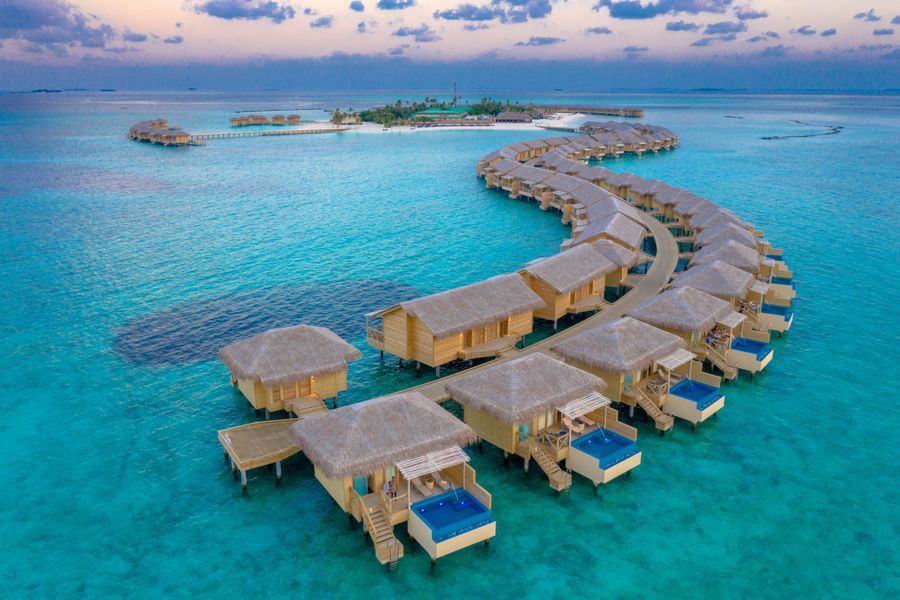
The Maldives is a chain of atolls, each with its own character, marine life and transfer options. A first trip works best when the atoll is chosen after the practical details, not before. Landing time, season and island type narrow the list quickly.
01
Start with your landing time
Velana International Airport sits on Hulhulé, the island beside Malé, and it is where nearly all visitors begin. From the terminal, an island is reached by speedboat, seaplane, domestic flight or public ferry. Which of these is realistic on the day you arrive depends on the hour you land, and that alone removes some atolls from a first night.
Seaplanes fly in daylight only, so an evening arrival usually means a night near the airport before flying out the next morning. Speedboats can run day and night, which makes atolls close to the airport, such as North and South Malé, easy for a late landing. Domestic flights follow a schedule and reach regional airports in the far north and south, with a boat transfer after landing.
- Speedboat range: North and South Malé, and some nearer islands, can be reached after dark.
- Seaplane range: Baa, Raa, Lhaviyani and Ari are usual seaplane atolls, in daylight.
- Domestic flight range: Laamu and Addu sit at the far ends of the chain and need a flight.
02
What you want to see
The second question is what you hope to see underwater. Mantas gather in Baa Atoll, particularly in the southwest monsoon when plankton is rich. Whale sharks are present in South Ari Atoll all year, and both snorkelling and diving encounters happen under a code of conduct that keeps a distance and forbids touching or flash.
Surf breaks are found in North Malé and in Laamu, with the surf season roughly March to October and the biggest swells around June to August. Hammerheads are associated with the channels off Rasdhoo in North Ari Atoll, though sightings are never guaranteed. Wrecks lie in several atolls and suit divers who prefer a structure to a reef.

03
Match the atoll to the season
The year turns on two monsoons. Iruvai, the northeast monsoon from roughly December to April, is drier and calmer. Hulhangu, the southwest monsoon from roughly May to November, brings more wind and passing showers, and choppier crossings. Air and sea stay warm all year.
Some marine life follows the seasons. Manta numbers in Baa are usually strongest in the southwest monsoon. Whale sharks in South Ari are present throughout the year, so that atoll suits any month. Surf swells are largest in the southwest monsoon, while the northeast monsoon months can bring smaller, cleaner waves on some breaks. Diving is possible all year, but visibility and currents vary with the monsoon.
04
Resort or local island
The next choice is island type. Resort islands hold one resort each, serve alcohol and arrange transfers. Inhabited local islands have guesthouses, villages, mosques and harbours, but no alcohol. Swimwear is allowed only on designated bikini beaches, and shoulders and knees are covered in the village.
Some atolls have both resort and local islands, which gives flexibility. North and South Malé have many local islands and are close to the airport. Baa and Raa have resort islands and some guesthouse islands. South Ari combines resorts with local islands near the whale shark area. Laamu and Addu are quieter and further away, with fewer choices but a different pace.
- Resort islands: one island, one resort, alcohol served, transfers arranged by the resort.
- Local islands: guesthouses, no alcohol, bikini beaches, village life.
- Mixed atolls: North and South Malé, Baa, Raa and South Ari have both types.
05
A shortlist of atolls
North and South Malé are the easiest for a first trip. They are close to the airport, speedboats run at night, and there is a wide choice of resorts and guesthouses. Diving includes wrecks and reef sites, and North Malé has surf breaks. South Malé is quieter and suits a slower stay.
Baa is the manta atoll, best in the southwest monsoon. Raa is quieter and reached by seaplane or domestic flight to Ifuru. North Ari has hammerheads off Rasdhoo and good diving. South Ari has whale sharks all year. Vaavu is small and known for night diving at Alimatha. Lhaviyani is a seaplane atoll with quiet reefs. Laamu has surf and seagrass, and Addu is the far south with its own airport and a link road.

06
Practical points before booking
Recreational diving in the Maldives is capped at 30 metres. Divers should carry certification and a logbook, and check that the dive centre offers the sites they want. Snorkellers can see much from a house reef, but the best manta and whale shark encounters often need a boat.
Reef care matters everywhere. Touching or standing on coral, collecting coral or shells, and feeding fish all harm the reef, and taking coral or shells out of the country is not allowed. Choose an atoll where the boat trips and the house reef match your interests, and ask the guesthouse or resort about current rules and fees before you go.
FAQ
Questions people ask
Which atoll is easiest to reach after a late landing?+
North or South Malé Atoll is usually the simplest. Speedboats run day and night from the airport, so a late arrival can reach an island the same evening. Seaplane atolls such as Baa or Raa need daylight, so a late landing usually means a night near the airport first.
When is the best time to see mantas in Baa Atoll?+
Manta numbers in Baa Atoll are usually strongest during the southwest monsoon, roughly May to November, when plankton is rich. Sightings are never guaranteed. Check with the dive centre or guesthouse for current conditions, as the monsoon timing shifts from year to year.
Can I see whale sharks in South Ari Atoll at any time of year?+
Yes, whale sharks are present in South Ari Atoll throughout the year, and both snorkelling and diving encounters happen under a code of conduct. Keep a distance, do not touch the sharks and do not use flash. Transfers to South Ari are by seaplane in roughly 25 to 40 minutes, or by speedboat in around 1.5 to 2 hours, depending on the island and conditions.
Which atolls are good for surfing on a first trip?+
North Malé and Laamu both have reef breaks. The surf season is roughly March to October, with the biggest swells around June to August during the southwest monsoon. The northeast monsoon months can bring smaller, cleaner waves on some breaks. Check with the local surf operator or guesthouse for current conditions.
Where can I dive with hammerheads in the Maldives?+
Hammerheads are associated with the channels off Rasdhoo in North Ari Atoll. Sightings are never guaranteed, and the dive is usually for experienced divers because of currents. Ask the dive centre about the season and conditions before booking, and remember the recreational diving limit is 30 metres.
Should I choose a resort island or a local island for my first atoll?+
It depends on what you want. Resort islands offer one resort per island, alcohol and arranged transfers. Local islands have guesthouses, no alcohol, and swimwear only on designated bikini beaches. Some atolls, including North and South Malé, Baa, Raa and South Ari, have both types, so you can compare.
How does the monsoon affect choosing an atoll?+
The northeast monsoon, roughly December to April, is drier and calmer. The southwest monsoon, roughly May to November, is windier with passing showers and choppier crossings. Some marine life follows the seasons, such as mantas in Baa. Air and sea stay warm all year, so diving and snorkelling continue in both monsoons.
Which atolls are best for wreck diving in the Maldives?+
Wrecks lie in several atolls, including North and South Malé and Vaavu. The best choice depends on your certification and experience, as some wrecks are deeper or have stronger currents. Ask the dive centre which wrecks suit your level, and check the current conditions before you book.
Is it possible to visit more than one atoll on a first trip?+
Yes, but transfers take time. Combining a near atoll such as North Malé with a seaplane atoll like Baa is possible if you allow a night near the airport between them. Domestic flights link the far atolls. Plan the connections with the resorts or guesthouses, as timetables and daylight limits affect the schedule.