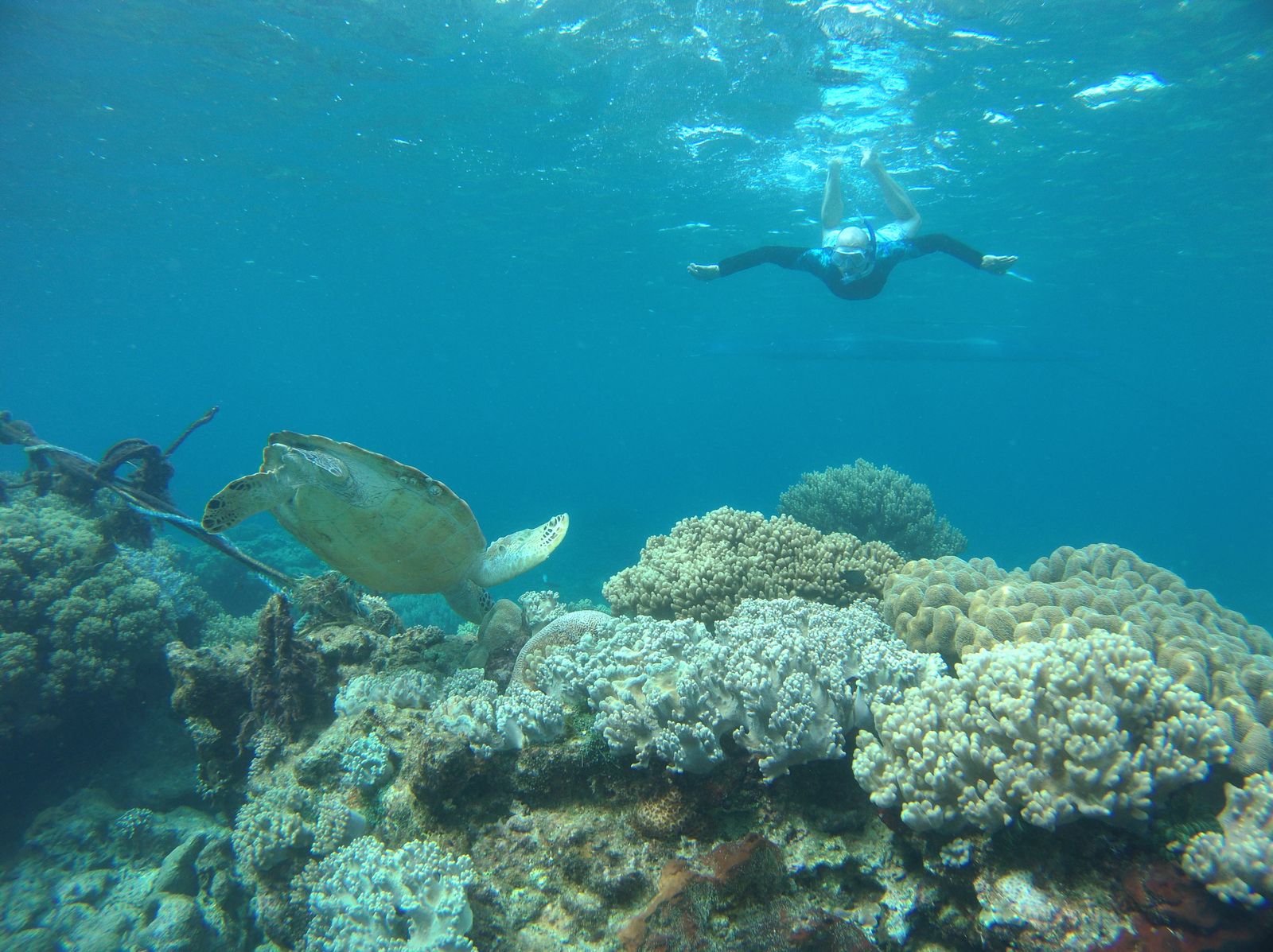
A house reef is the reef that fringes the island you are staying on. You can usually walk in from the beach, which makes it the simplest snorkelling in the Maldives. This page explains how to read the water, use the entry points and leave the reef as you found it.
01
What a house reef is
A house reef is the coral reef that grows along the edge of an island. On the lagoon side it is shallow and sandy; further out, the reef flat gives way to a slope or a drop-off into deeper water. Because it belongs to the island, you can usually reach it on foot from the beach.
Most resort islands and many inhabited islands have one. The quality and accessibility vary: some have a wide, shallow reef flat that is easy to explore, others have a narrow fringe and a steep drop close to shore. The best way to judge is to look at the water from the beach at low tide, or ask staff where the reef starts.
The reef is a living structure built by corals. The shallow parts are exposed at low tide, so timing your swim with the tide matters. At high tide you can often float over more of the reef, but currents can be stronger.

02
Entry points and currents
Use the marked entry and exit points. Resorts and guesthouses often clear a channel through the shallow reef or mark a safe gap in the coral. These are chosen because the water is deep enough to swim and the current is manageable. Do not invent your own entry over shallow coral.
Ask staff about currents and tide before you go in. Currents can run along the reef edge, especially as the tide turns. A guide or dive centre can tell you which direction the water is moving and where it is safe to swim. If you are unsure, snorkel in the lagoon instead.
Never snorkel alone. A buddy can watch for boats, help if you tire and call for assistance. Float on the surface and do not stand on coral. Coral is fragile and can cut you; standing on it also kills the polyps. Keep your fins up and your body horizontal.
- Marked entry: use the gap in the reef that staff have cleared.
- Current check: ask staff which way the water is moving.
- Buddy: never snorkel alone.
- Float: do not stand on coral or touch it.
- Fins up: keep kicks shallow to avoid stirring sand.
03
Fish, turtles and sharks
The shallow reef is full of small fish: damselfish, wrasses, parrotfish and butterflyfish. They graze on algae and coral. Reef sharks and turtles are common on the reef edge and are harmless if left alone. A turtle may surface to breathe beside you; give it space and do not chase it.
Reef sharks are usually small and shy. They patrol the drop-off and the reef flat. Seeing one is a normal part of snorkelling in the Maldives. Do not corner them or try to touch them. Keep your distance and let them swim away.
Feeding fish is harmful. It changes their behaviour and can make them aggressive towards swimmers. Do not feed anything, and do not collect shells or coral. Taking coral or shells out of the country is not allowed.

04
When to snorkel
The best light is around midday, when the sun is high and the water is clearest. Calmer water is often in the morning, before the wind picks up. The Maldives has two monsoons: Iruvai, the northeast monsoon, roughly December to April, is drier and calmer; Hulhangu, the southwest monsoon, roughly May to November, is windier with passing showers.
Air and sea stay warm all year. The difference is in the wind and the chop. On windy days, the lagoon side of the island is usually calmer than the reef edge. Ask staff which side of the island is sheltered.
Tides matter too. At low tide, the shallow reef may be exposed and the entry channel may be shallow. At high tide, more water covers the reef but currents can be stronger. A local guide or the dive centre can tell you the best window.
05
Gear and sun protection
A well-fitting mask and snorkel are the most important items. Fins help you move without using your hands, which keeps you off the coral. Many resorts and guesthouses lend or rent gear; check it fits before you leave the beach.
Wear a rash guard for sun protection and to reduce contact with stinging plankton. Use mineral sunscreen and apply it well before entering the water, as some ingredients harm coral. Better still, cover up with a long-sleeved top and leggings.
Know your limits. Snorkelling is tiring if you are not used to it. Stay close to shore, rest on the beach if needed, and do not swim out beyond the reef edge unless you are with a guide. If you get caught in a current, swim parallel to the shore until you are out of it, then head in.
- Mask fit: check the seal before you swim.
- Rash guard: protects from sun and plankton.
- Mineral sunscreen: apply before you enter the water.
- Stay close: do not swim beyond the reef edge alone.
06
Reef-safe habits
Touching or standing on coral, collecting coral or shells, and feeding fish all harm the reef. Coral grows slowly; a broken branch may take years to recover. Shells are part of the reef ecosystem, and removing them is not allowed.
Keep a respectful distance from all marine life. Do not chase, ride or handle turtles, sharks or rays. If an animal approaches you, stay still and let it pass. Do not block its path to the surface or to the open water.
On local islands, swimwear is only allowed on designated beaches, often called bikini beaches. In the village, cover shoulders and knees. Importing alcohol and pork is not allowed. These rules apply to everyone, and following them keeps the reef and the community healthy.
FAQ
Questions people ask
Do I need a guide to snorkel the house reef?+
Not always. Many house reefs can be snorkelled from the beach without a guide, but you should never snorkel alone. Ask staff about currents and the best entry point. A guide is useful if you are unsure of conditions or want to go further along the reef.
Is house reef snorkelling safe for children?+
It can be, but children need supervision and a well-fitting mask. The lagoon side is usually calmer and shallower. Ask staff where it is safe for children to swim, and keep them close. A rash guard and fins help them stay comfortable.
What will I see on a house reef?+
Expect small reef fish such as damselfish, parrotfish and wrasses. Turtles and reef sharks are common on the reef edge and are harmless if left alone. Coral cover varies by island. Do not touch or feed anything, and keep your distance from animals.
When is the best time to snorkel the house reef?+
Around midday for the best light, and often in the morning for calmer water. The northeast monsoon, roughly December to April, brings drier and calmer weather. The southwest monsoon, roughly May to November, is windier. Check daily conditions with the dive centre or guesthouse.
Can I stand on the coral to rest?+
No. Standing on coral damages it and can cut you. Coral is made of living animals that grow slowly, and a single footstep can break branches that take years to recover. Float on the surface and use fins to move. If you need to rest, return to the beach or use a sandy patch. Never touch or hold onto coral.
What should I wear for house reef snorkelling?+
A swimsuit or rash guard, plus a well-fitting mask, snorkel and fins. A rash guard protects against sun and stinging plankton. Use mineral sunscreen applied before you enter the water. On local islands, swimwear is only allowed on designated beaches.
Are there reef sharks on the house reef?+
Reef sharks are common on the reef edge and are harmless if left alone. They are usually small and shy. Do not corner or touch them. Keep your distance and let them swim away. Seeing one is a normal part of snorkelling in the Maldives.
Can I snorkel the house reef at low tide?+
At low tide the shallow reef may be exposed and the entry channel may be shallow. It is often better to snorkel at mid to high tide, but currents can be stronger then. Ask staff for the best window and use the marked entry point.
Do I need to bring my own snorkelling gear?+
Many resorts and guesthouses lend or rent masks, snorkels and fins. Check the fit before you swim. If you have your own mask, bring it for comfort. A rash guard is useful to bring. Ask your accommodation what is available.


