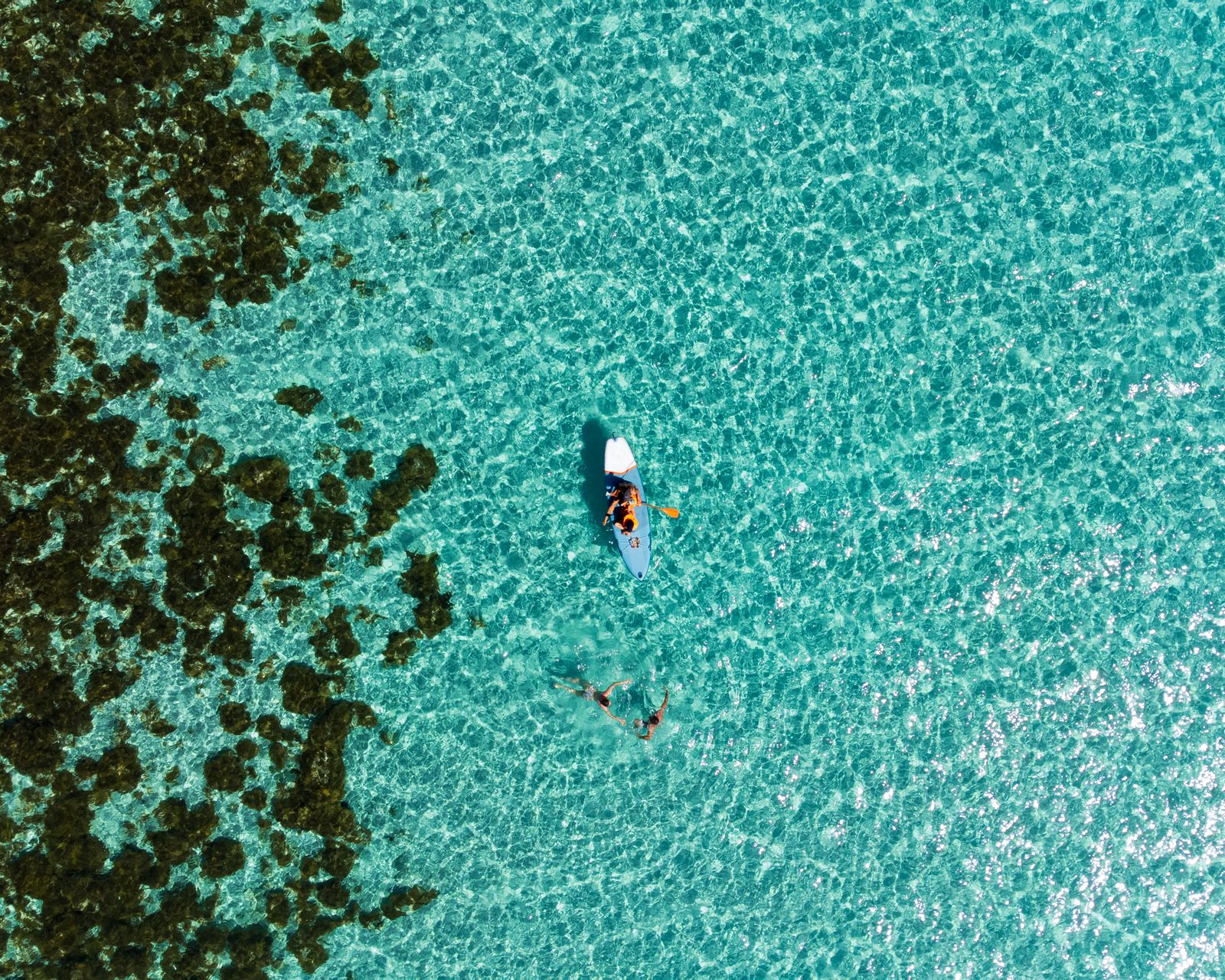
Kayaks and paddleboards are widely available on resort islands and increasingly on local islands, usually for hire by the hour. Lagoons are the easiest water in the Maldives, but wind, tide and boat traffic still matter. Go with a guide or stay inside marked areas, and wear a buoyancy aid.
01
Where to paddle
Almost every island sits inside a lagoon, the shallow sandy shelf between the beach and the reef edge. On resort islands the lagoon is usually the first water you see, and kayaks and paddleboards are kept near the beach or the watersports hut. On local islands, guesthouses increasingly keep a few boards or kayaks for guests, though not every island has them.
The easiest water is the inner lagoon, where the bottom is sand and the depth is knee to chest high for a long way out. The reef edge is different: beyond it the shelf drops away and the water becomes deeper and more exposed. Channels cut through the reef for boats, and these are not places to paddle.
Availability varies by island and by season. Some places include a kayak or board with the room, others hire by the hour or half day. Ask what is included before you book, and ask whether a buoyancy aid comes with the board.
- Inner lagoon. Shallow sand, shelter from the reef, easiest for beginners.
- Reef edge. Deeper water and more exposure; keep a margin.
- Channels. Boat routes through the reef; stay well clear.
- Marked areas. Where the island sets a boundary, stay inside it.

02
Wind, tide and timing
The Maldives turns on two monsoons. Iruvai, the northeast monsoon from roughly December to April, is drier and calmer. Hulhangu, the southwest monsoon from roughly May to November, is windier with passing showers. Air and sea stay warm all year, so the paddling season does not close, but the windier months give more days when the lagoon is choppy.
Even in a calm month, the day matters. Early morning is often the calmest window, before the breeze builds. Tide matters too: a falling tide can expose shallow patches of reef flat, and a strong current can run through a channel or along the reef edge. Ask at the watersports desk or the guesthouse what the tide is doing that day.
Boat traffic is the third factor. Dhoni and speedboats use the channels and sometimes cross the lagoon. Keep to the side, cross channels quickly and directly rather than drifting in them, and do not stop in the middle of a boat route.
03
Boards, kayaks and safety
Sit-on-top kayaks are the usual hire boat: stable, easy to get back onto, and forgiving for beginners. Stand-up paddleboards come in different sizes, and a wider board is easier on a first outing. A leash attaches the board to your ankle; on a shallow reef it is worth knowing that a leash can snag, so ask how the local operation rigs it.
Wear a buoyancy aid. On resort islands these are normally provided with the hire, but check. On local islands, equipment and safety gear vary more, so ask what comes with the board. A rash guard or quick-dry top helps with sun and with the board itself.
Reef-safe habits apply on the water as much as in it. Do not stand on coral, do not drag a board or kayak over the reef, and do not collect coral or shells. Feeding fish is not allowed. Keep a clear distance from the reef edge and from any turtles or rays you pass.
- Buoyancy aid. Wear one; ask if it is included with the hire.
- Leash check. Ask how the board is rigged over shallow reef.
- No standing on coral. Push off with your hands, not your feet, if you ground.
- No collecting. Coral and shells stay on the reef; taking them out is not allowed.
04
A first session
Start close to shore in the inner lagoon, where you can stand up if you fall in. Kneel on the board first, then stand once you are stable. On a kayak, keep the paddle short and the strokes even. Most people find the balance within a session.
A guide is worth it if you want to go further along the reef or into water you do not know. Guides know the tide, the channels and the shallow patches, and they can keep a group together. On resort islands, guided paddles are often offered; on local islands, ask the guesthouse whether someone can go with you.
Children can paddle, but the age and swimming requirements are set by the operator. Ask before booking, and keep a child in a buoyancy aid and within reach.

05
Paddling on local islands
On inhabited islands, guesthouses are the usual source of kayaks and boards, and availability is growing but not universal. Ask when you book rather than on arrival. The lagoon is shared with fishing boats and harbour traffic, so keep clear of the harbour mouth and the boat routes.
Swimwear rules apply on local islands. Wear swimwear only on the designated beach, often called a bikini beach, and cover shoulders and knees in the village. A rash guard is useful for both the sun and the walk back from the beach.
During Ramadan, eating and drinking in public in daylight is avoided on local islands. Paddling itself is unaffected, but keep the usual courtesy ashore. Importing alcohol and pork is not allowed, which is worth knowing if you plan to bring supplies.
06
Choosing an island
Atolls close to Velana International Airport suit short trips, because speedboats can run day and night. North and South Malé Atoll are the closest, and their resort lagoons are the easiest place to try a board for the first time. Seaplanes fly in daylight only, so a seaplane transfer ties you to a daytime arrival.
Further atolls are reached by scheduled domestic flight, often with a boat transfer at the end. Dharavandhoo in Baa, Maamigili in South Ari, Ifuru in Raa, Kadhdhoo in Laamu and Gan in Addu all have airports. A lagoon is a lagoon in any atoll, so the choice is really about transfer time, budget and whether you want a resort or a guesthouse.
Wherever you stay, the resort or guesthouse arranges transfers and knows the local water. Ask them about kayak and paddleboard hire at the same time, so you know what to expect on arrival.
FAQ
Questions people ask
Do I need experience to kayak or paddleboard in the Maldives?+
No. The inner lagoon is shallow and sheltered, which suits beginners. Start close to shore where you can stand up, and use a buoyancy aid. A guide helps if you want to go further along the reef or into water you do not know. Ask the operator about any minimum swimming requirement.
Is kayak and paddleboard hire included with accommodation?+
It varies. Some resort islands include a kayak or board with the room, others hire by the hour or half day. On local islands, guesthouses increasingly keep a few boards, but not every island has them. Ask what is included before you book, and whether a buoyancy aid comes with the hire.
When is the best time of day to paddle a lagoon?+
Early morning is often calmest, before the breeze builds. Wind, tide and boat traffic all change through the day, so ask the watersports desk or guesthouse about conditions before setting out. The windier southwest monsoon, roughly May to November, gives more choppy days than the drier northeast monsoon.
Can I paddle during the southwest monsoon?+
Yes. Air and sea stay warm all year, and the paddling season does not close. Hulhangu, roughly May to November, is windier with passing showers, so there are more days when the lagoon is choppy. Choose the calmest window of the day and follow local advice about conditions.
What should I wear for kayaking or paddleboarding in the Maldives?+
A rash guard or quick-dry top helps with sun and with the board, and a buoyancy aid is worn over it. On local islands, wear swimwear only on the designated beach and cover shoulders and knees in the village. Reef-safe sunscreen applied before you enter the water is the better choice.
Is it safe to paddle near the reef edge or a channel?+
The reef edge is deeper and more exposed than the inner lagoon, and channels are boat routes. Keep a clear margin from the edge, cross channels quickly and directly rather than drifting in them, and do not stop in the middle of a boat route. A guide is the safer option for water you do not know.
Can children kayak or paddleboard in the Maldives?+
Often, but the age and swimming requirements are set by the operator. Ask before booking, keep a child in a buoyancy aid and within reach, and start in the shallow inner lagoon. Resort islands usually have staff on hand; on local islands, ask the guesthouse who supervises the equipment.
What reef-safe rules apply when kayaking or paddleboarding?+
Do not stand on coral, do not drag a board or kayak over the reef, and do not collect coral or shells. Feeding fish is not allowed, and taking coral or shells out of the country is not permitted. Keep a clear distance from turtles, rays and the reef edge, and push off with your hands if you ground.
Which atolls are easiest for a kayak or paddleboard trip?+
North and South Malé Atoll are closest to Velana International Airport, and speedboats can run day and night, which suits short trips. Further atolls are reached by scheduled domestic flight and a boat transfer. A lagoon is a lagoon in any atoll, so the choice is really about transfer time and whether you want a resort or a guesthouse.


