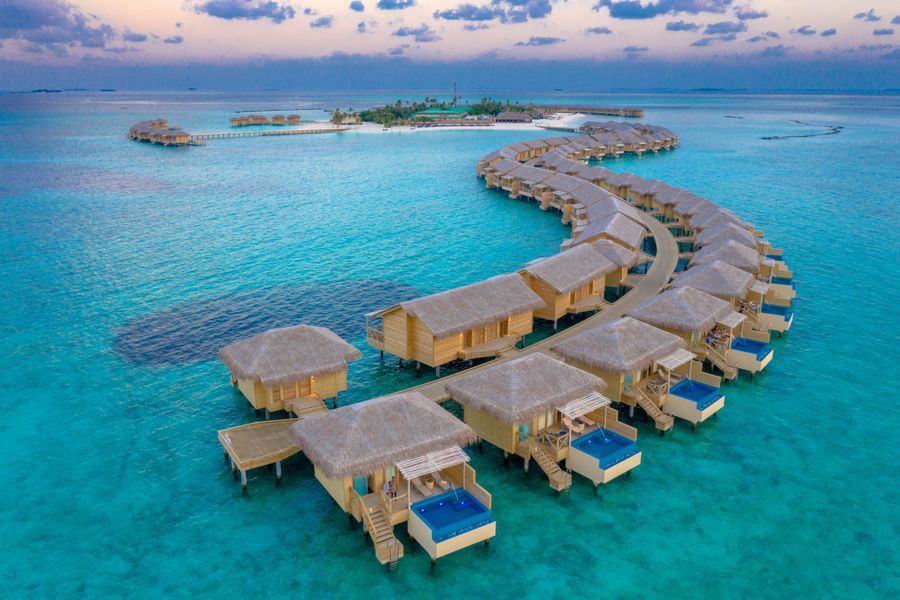
There is no winter in the Maldives. The air and the sea stay warm all year. What turns is the wind, and the whole country turns with it.
01
A country run by the wind
Ask about the weather in the Maldives and the answer comes in two words: Iruvai and Hulhangu. They are the Dhivehi names for the two monsoons, the northeast and the southwest, and between them they decide how the sea looks, where the fish are, which way the boats sail and when the surf comes in.
There is no winter here. Air and sea stay warm all year. What changes is the wind, and with it the rain, the swell and the direction the currents run through the atoll channels.
02
Iruvai, the northeast monsoon
Iruvai blows roughly from December to April. It is the drier half of the year: long sunny spells, calmer seas, and the clearest water of the year on the eastern side of the atolls. It is also the busiest season for visitors, which is why rooms and seaplane seats fill early.
For divers, Iruvai is the season of visibility. Currents tend to flow from east to west across the atolls, carrying clear ocean water in on the eastern channels.

03
Hulhangu, the southwest monsoon
Hulhangu arrives around May and lasts into November. The wind picks up, showers pass through, often heavy and often short, and boat crossings get choppier. Some days are grey. Many are not.
What Hulhangu brings is life in the water. Currents reverse and carry plankton through the atolls, and the large filter feeders follow it. This is the season when manta rays gather at Hanifaru Bay in Baa Atoll, and when surfers come for the bigger swell on the reef breaks of North Malé and the south.

04
The mantas change sides
One of the neat consequences of the monsoon is that manta rays tend to switch sides of the atolls with the season. Plankton collects on the downstream side of an atoll, where the current exits, and the mantas go where the food is.
In broad terms, that puts them on the western sides of atolls during Iruvai and on the eastern sides during Hulhangu. Local dive centres know which sites are working in which month, and plan around it.
- Iruvai: mantas more often on western sides of atolls; clearest water on eastern channels.
- Hulhangu: mantas more often on eastern sides; feeding at Hanifaru Bay in Baa.
05
The months in between
The change between monsoons is not a switch. April and May, and again around November, are transitional months when the wind can be light and variable. These shoulder months can be some of the calmest of the year, and are quieter than the peak of Iruvai.
06
So which month?
There is no bad month, only a different one. If you want calm seas, dry days and the best visibility, aim for Iruvai and book early. If you want mantas at Hanifaru, surf, or a quieter trip, Hulhangu is the season, as long as you accept some rain and choppier crossings.
Whichever you pick, the monsoon is worth knowing before you choose an atoll, because it decides what you will see when you put your face in the water.
FAQ
Questions people ask
Does it rain all day in the southwest monsoon?+
Usually not. Showers are often heavy but short, with sunny spells between. Some days are overcast and windy.
Is the sea warm all year?+
Yes. The water stays warm through both monsoons, which is why there is no cold season.
When is the best surf?+
The southwest monsoon brings the bigger swell, broadly from about March to October, with the reef breaks of North Malé and the south busiest then.
When do mantas feed at Hanifaru?+
During the southwest monsoon, broadly May to November, when conditions bring plankton into the bay.
Which way do the currents run through the atoll channels during Iruvai?+
During Iruvai, currents tend to flow from east to west across the atolls. Clear ocean water is carried in on the eastern channels, which is why that side of the atolls has the clearest water of the year in this season. Dive centres plan sites around the flow.
Which side of an atoll do mantas use in each monsoon?+
Plankton collects on the downstream side of an atoll, where the current exits, and mantas follow the food. In broad terms they are found more often on western sides during Iruvai and on eastern sides during Hulhangu. Dive centres know which sites are working in a given month.
Are April, May and November calm?+
The change between monsoons is not a switch. April and May, and again around November, are transitional months when the wind can be light and variable. These shoulder months can be some of the calmest of the year and are quieter than the peak of Iruvai. Timing shifts from year to year.
Why are seaplane seats hard to find in Iruvai?+
Iruvai, roughly December to April, is the drier, calmer half of the year and the busiest season for visitors. Rooms and seaplane seats fill early, so booking ahead matters if calm seas, dry days and clear water are the aim. Seaplanes fly in daylight only.
How do boat crossings differ between the two monsoons?+
Crossings are calmer during Iruvai, roughly December to April. In Hulhangu, roughly May to November, the wind picks up and crossings get choppier, though showers are often short. Speedboats run day and night, which suits atolls close to the airport, while seaplanes fly in daylight only.